STYLE. COLOR. SPARKLE. CONFIDENCE.
Petite Style After 40: 10 Ways to Dress Your Proportions With Confidence
Apparently, I am shrinking. (Anyone else hearing I’m melting, from the Wizard of Oz…)
I have said for years that I am 5’2″. My driver’s license says I am 5’2″. But at my latest doctor’s appointment, they informed me that I am now 5’1½”.
I’m keeping the 5’2″ for now. 😂
Either way, I have spent my entire adult life dressing a petite body. And the more I have learned as a Certified Image Consultant, the more I realize that petite style after 40 isn’t about trying to make ourselves look taller. It is about understanding proportion.
That distinction matters.
I don’t want to give you another list of fashion rules telling you what you can and cannot wear because you’re vertically challenged. I want to help you understand why certain things work, so you can make better decisions for your own body.
Because once you understand proportion, getting dressed gets a whole lot easier.
First, What Does Petite Actually Mean?
Here’s something that surprises a lot of women.
In the clothing industry, 5’4″ and under is generally considered petite.
And petite does NOT mean skinny.
It doesn’t mean size 2. I was still considered petite when I was a size 16.
It doesn’t mean tiny everywhere.
You can be petite at many different clothing sizes and with many different body shapes. Petite sizing is primarily about height and proportion.
In fact, petite clothing isn’t simply regular clothing with a few inches chopped off the bottom. J.Crew’s Petite Shop is a great example. They design their petite clothing for women 5’4″ and under, adjusting details such as knee placement, rise, bodice length, armholes, shoulders, sleeves and even lapel size.
In other words, petite clothing is about more than a shorter hem. That right there was a newsflash to me! The proportions of the entire garment can be different.
That may explain something you’ve experienced in a fitting room.
Have you ever tried something on and thought, “It fits, but something still looks off”?
It may not be your body.
The proportions of the garment may simply be sitting in the wrong places.
And friend, THAT is useful information.
10 Petite Style Tips That Are Really About Proportion
These aren’t commandments.
Think of them as tools. Try them. Stand in front of the mirror. Take a picture. Compare. See what works for YOUR proportions. Send me your pictures, I would love to see them!
1. Create a Longer Visual Line
Our eyes follow lines.
When an outfit has fewer abrupt visual stops, the eye moves more easily from top to bottom. That can create a longer, more balanced appearance on a petite frame.
One easy way to do this is with similar or lower-contrast colors through your outfit. You don’t have to dress head-to-toe in one color every day.
You might wear dark-wash jeans with a navy top, or black pants with a charcoal jacket. Even matching your outer layer more closely to your bottoms can help create continuity.
This is also why vertical seams, open jackets and long necklaces can be such useful styling tools.
We’re simply giving the eye somewhere to travel.
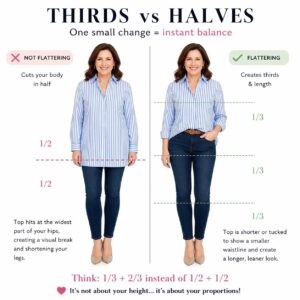
2. Think Thirds, Not Halves
This is one of my favorite principles when it comes to petite style after 40, because a small change in proportion can make such a difference.
Imagine dividing your body visually in half, 50% top and 50% bottom.
That strong horizontal break can make a petite frame appear shorter and boxier.
Instead, try creating approximately one-third on top and two-thirds on the bottom, or occasionally the reverse depending on the outfit and your proportions.
A tucked top with a higher-rise pant is an easy example. So is a shorter jacket over a longer lower half.
This doesn’t mean I expect you to stand in front of the mirror with a tape measure!
We’re working with your body, not a ruler.
The idea is simply to experiment with an uneven visual division rather than automatically cutting yourself in half.
3. Pay Attention to Where Your Tops and Jackets End
A couple of inches can make a surprisingly big difference on a petite woman.
If a top ends at the widest part of your hip, it can create a strong horizontal line right where you may not want one.
The same thing happens with jackets and coats.
Look at more than whether the garment technically “fits.” Where do the shoulders sit? Where does the waist of the garment hit? Are the sleeves overwhelming your hands? Where does the jacket end compared with your natural waist and hip?
This is also one reason shopping the petite department can be helpful. Sometimes we don’t need a smaller size. We need the garment’s proportions moved to the right places.
Pro Tip: Sleeves too long? Push them up to 3/4 length! It shows a little wrist, draws the eye toward your waist, and instantly gives your outfit a more modern, styled look.
4. Choose Your Rise With YOUR Proportions in Mind
You’ve probably heard that petite women should always wear high-rise pants because they make our legs look longer.
Often, a higher rise can do exactly that.
But here’s where I don’t love absolute fashion rules.
Two women can both be 5’2″ and have completely different proportions. One may have a longer torso and shorter legs. Another may have a shorter torso and proportionally longer legs.
Put the exact same high-rise pant on both women and it may not have the same effect.
So yes, experiment with a higher rise, especially if you’d like to create a longer leg line. But pay attention to where that waistband actually lands on YOU.
Labels don’t mean the same thing for everyone. And remember, not all brands fit the same! One brand’s high rise may fit more like a mid-rise on the next person.
5. Don’t Be Afraid of Volume, Balance It
“Petites can’t wear oversized clothes.”
Nope. I’m not giving you that rule.
You absolutely can wear an oversized blazer, relaxed sweater or wide-leg pant.
But you may find that one relaxed piece at a time is easier to balance on a petite frame.
If you’re wearing a roomy wide-leg pant, try a more fitted or defined top. If you’re wearing an oversized blazer, perhaps what is underneath has a little more shape.
It’s the difference between intentionally wearing an oversized piece and feeling like your clothes are wearing you.
And yes, there IS a difference.
6. Let Your Shoes Continue the Line
This one is so fun to experiment with because changing your shoes can change the entire look without changing one piece of clothing.
A low-vamp shoe, one that exposes more of the top of your foot, can visually continue the leg line.
Pointed and almond toes can do something similar by extending the eye forward.
And no, petites do NOT have to live in heels.
Flats can work beautifully, and good news, they are very on trend for Fall 2026! Kitten heels are having a moment too.
Also look at color. A shoe that is similar in tone to your skin, pants or tights can keep the eye moving. A very high-contrast shoe may create a stronger visual stop.
Neither is automatically wrong.
Now you understand what each choice does, and YOU get to decide what you want.
7. Keep Scale in Mind
Scale is something we don’t talk about nearly enough. And I am NOT talking about your weight!
If you have a smaller frame, an enormous print, oversized handbag, very wide lapel or huge design detail can sometimes overwhelm you.
Notice I said can.
This is not where I confiscate your statement jewelry. You know me better than that!
Instead, look at the entire outfit.
Does that fabulous accessory complement you, or is it the first and only thing you see?
Does the print enhance you, or does it wear you?
Sometimes changing the scale slightly is all it takes to make an outfit feel more balanced.
8. Create a Waistline When It Works for Your Body
Defining the waist can be incredibly helpful for petite proportions.
A front tuck, belt, cropped jacket or simply choosing a top that ends at a flattering point can help establish where your upper body ends and your legs begin.
But this is another place where body shape matters.
Petite is not a body shape.
A petite woman with a b body shape, O body shape, d body shape or X body shape may need different styling strategies.
Not sure what your body shape is? That’s exactly what we uncover during a Body Styling + Jewelry Experience.
That’s why I never want you thinking, “Royanna said every petite woman has to tuck in her shirt.”
Nope. Nor do I recommend that. Same with belts.
I want you to understand what creating a visible waistline can do, and then determine whether and how that principle works on your body.
9. Show a Little Ankle or Wrist
Sometimes a little bit of skin gives an outfit the breathing room it needs.
Rolling or pushing up a sleeve to reveal the wrist can keep a jacket or sweater from overwhelming a smaller frame.
An ankle-length pant can do something similar, especially when paired with a low-vamp shoe.
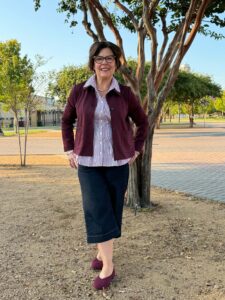
Petite confession: See those tan ankle-length pants I’m wearing in the photo above? I cut FOUR INCHES off the bottom of them! 😂 They had a raw hem to begin with, so rather than paying to have them shortened and recreating the raw edge, I took advantage of the trend and made them work for me.
That’s one of my favorite things about some of today’s raw-hem styles. Sometimes the petite solution really can be a pair of scissors! Of course, I am talking about a garment that’s supposed to have a raw hem, so please don’t start chopping four inches off every pair of pants in your closet and tell them Royanna sent you. 😂
10. Think Proportion Over Petite “Rules”
If you remember only one thing from this article, let it be this:
Being petite isn’t about limitations. It’s about being intentional.
You can wear the maxi dress.
You can wear wide-leg pants.
You can wear the oversized blazer.
You can wear flats.
You can carry the fun handbag.
The better question isn’t, “Am I allowed to wear this because I’m petite?”
Ask:
“How can I style this so the proportions work for me?”
That is a completely different way of getting dressed.
Petite Style Myths We Can Stop Believing
One of the things I want women to understand about petite style after 40 is that most of the so-called rules aren’t really rules at all.
Let’s bust a few while we’re here.
MYTH: Petite women can’t wear wide-leg pants.
Yes, we can. Pay attention to rise, length, volume and what you’re pairing with them.
MYTH: Petite women shouldn’t wear maxi dresses.
Also no. Look at where the waist falls, how much fabric you’re carrying and whether the overall silhouette works with your proportions.
MYTH: Petites need heels to look taller.
Absolutely not. A great flat with a low vamp, flattering toe shape or lower contrast can create a beautiful line.
MYTH: Petites can’t wear oversized clothing.
You can. Try balancing one relaxed piece with something more streamlined.
MYTH: Petite styling is about trying to look taller.
This may be the biggest one of all.
My goal isn’t to make my 5’1½” body magically appear 5’8″.
And apparently my doctor isn’t going to help me gain that half inch back either. 😂
The goal is proportion, balance and confidence.
Mindset Matters: Your Height Isn’t Something to Fix
I think this is especially important for those of us over 40. Truth? I am very close to 60 now.
Our bodies change. Hello menopause!
Sometimes our weight changes. Our shape changes. Our posture changes. Apparently, our height can even change!
It is easy to start looking at our bodies as a collection of things that need to be fixed.
I don’t want that for you.
One of the verses I come back to is Psalm 139:14 NIV:
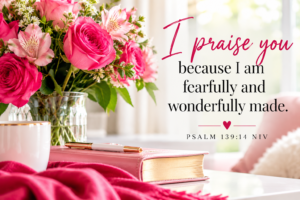
I believe we can learn how to dress our bodies well while still appreciating the bodies God gave us.
Those two things are not opposites.
Learning your proportions isn’t about hiding yourself or wishing you had someone else’s legs, waist or height. It’s about understanding yourself better.
That is one of the reasons I love what I do.
I’ve watched women go from saying, “Nothing looks good on me,” to realizing that they had been choosing clothes that weren’t working with their proportions.
What a difference between “Something is wrong with my body” and “Ohhhh, THAT’S why this jacket never looks right!”
Friend, I will take the second one every time. I wrote about this here: Confidence After 40
Two Petite Women Can Be the Same Height and Need Different Clothes
This is where all those petite tips on Pinterest, Instagram and TikTok can only take us so far.
That’s why petite style after 40 can’t be reduced to a checklist. Your individual proportions matter.
You and I could both be 5’2″.
You might have a long torso and shorter legs. I might have a shorter torso. Your shoulders may be broader. Your body shape may be completely different from mine.
That’s why I want to help women understand their proportions rather than dress according to a list of rules.
When I work with a woman during a Body Styling appointment, we’re looking at HER.
Her body shape.
Her proportions.
Her necklines.
Her silhouettes.
Her clothing lengths.
Her accessories.
And how all of those pieces work together.
Because once you understand the WHY, you can stop standing in fitting rooms wondering why something that looked fabulous on someone else isn’t working on you.
It doesn’t mean there is anything wrong with your body.
It may simply mean you need a different proportion.
Wondering what a Body Styling appointment is actually like?
I created this quick video to show you what we look at and how understanding your body shape and proportions can make getting dressed so much easier.
Petite Style After 40 Should Give You More Freedom, Not More Rules
I started this article by telling you that I’m somewhere between 5’1½” and 5’2″.
I’m ending it hoping you’ll remember something much more important than my height.
Style can be learned. And I am the first to admit, I didn’t have a personal style until summer of 2025!
You don’t need to memorize a hundred petite rules.
Start noticing proportion.
Try the tuck and then untuck it.
Change the shoe.
Push up the sleeve.
Try the petite jacket instead of the regular one.
Take a mirror selfie of both versions. Sometimes that picture tells you more than staring at yourself in the mirror ever will.
And most importantly, stop using clothes that don’t work as evidence that something is wrong with your body.
Sometimes it’s not you.
Sometimes it’s the clothes.
And once we understand our proportions, we can shop on purpose, style with intention and spend a whole lot less time second-guessing ourselves.
That’s a confidence boost at any height.
Ready to Understand YOUR Proportions?
If you’ve been wondering why certain clothes never seem quite right, a Body Styling + Jewelry Experience can help you understand your individual body shape, proportions, silhouettes, necklines and accessories.
We’ll work with YOUR body, YOUR proportions and YOUR life, and give you practical tools you can actually use the next time you get dressed or go shopping.
Because you don’t need more rules.
You need to know what works for YOU.